For decades, Alzheimer’s disease has been widely regarded as a progressive, irreversible neurodegenerative condition. Most research efforts have focused on slowing disease progression, reducing amyloid plaques, or managing symptoms. But a recent study published in Cell Reports Medicine challenges that long-held belief, by showing that restoring the brain’s energy balance can not only prevent but reverse advanced Alzheimer’s pathology in mice.
Alzheimer’s Disease: A Brief Primer
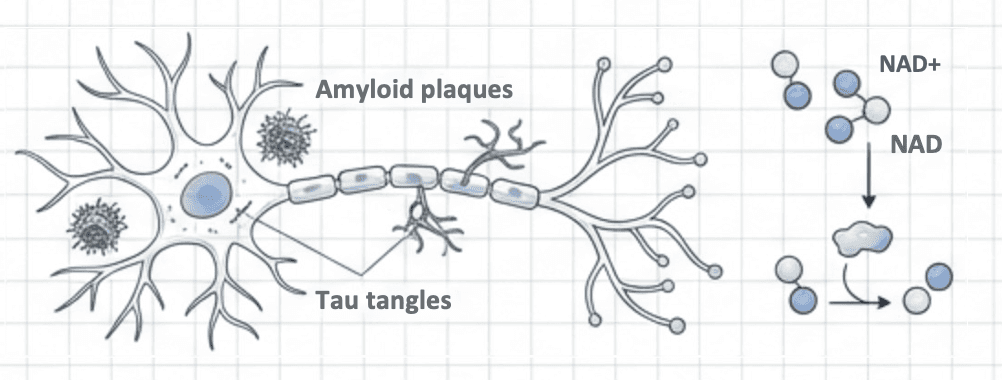
Alzheimer’s disease (AD) is the most common cause of dementia, affecting millions of people worldwide. It is characterized by the accumulation of amyloid-β plaques and neurofibrillary tangles composed of hyperphosphorylated tau protein, leading to neuronal loss, cognitive decline, memory impairment, and, eventually, loss of independence.
For a century, the field assumed that once extensive neuropathology developed, the brain could not repair itself. Current FDA-approved therapies aim to slow progression and reduce certain biomarkers, but none have convincingly led to recovery of lost cognition in humans.
The New Frontier: NAD⁺ and Brain Energy Balance
The study in Cell Reports Medicine identifies dysregulation of NAD⁺ (nicotinamide adenine dinucleotide),a central metabolic cofactor, as a key contributor to Alzheimer’s pathology. NAD⁺ plays a vital role in cellular energy metabolism, mitochondrial function, and stress responses across virtually all cell types.
Researchers found that:
NAD⁺ levels fall dramatically in the brains of both humans with Alzheimer’s and Alzheimer’s model mice.
This loss of NAD⁺ disrupts critical cellular functions, contributing to inflammation, tau pathology, blood-brain barrier breakdown, and neuronal dysfunction.
Instead of merely preventing NAD⁺ decline, the team tested whether restoring NAD⁺ homeostasis could reverse pathology and cognitive deficits.
The Breakthrough: P7C3-A20 Restores Cognitive Function in Mice
To restore NAD⁺ balance, the researchers used a small molecule called P7C3-A20, which enhances the NAD⁺ salvage pathway.
They applied this compound to two genetically distinct mouse models of Alzheimer’s:
A mouse model driven by amyloid pathology
A mouse model driven by tau pathology
In both models, treatment with P7C3-A20 not only halted disease progression, it reversed major pathological hallmarks and led to restoration of cognitive abilities as measured by behavioral tests.
Here’s what changed in the brains of treated mice:
Reversal of amyloid and tau abnormalities
Restored blood-brain barrier function
Renewed neural growth and connectivity in areas of the brain critical for memory
Implications for the Future of Alzheimer’s Treatment
This research is preliminary, and in mice. While this data is valuable, it does not fully replicate the complexity of human Alzheimer’s disease. More clinical research, specifically in humans, is needed.
These avenues could eventually reshape how we think about neurodegenerative diseases, shifting from management to recovery-oriented approaches.
References:
All key finding pulled from “Pharmacologic reversal of Alzheimer’s disease in mice reveals potential therapeutic nodes in human brain” from Cell Reports Medicine
https://www.cell.com/cell-reports-medicine/fulltext/S2666-3791(25)00608-1