Testosterone gets blamed for a lot: for low energy, low sex drive, trouble building muscle, irritability. And while it can absolutely be a culprit, it’s not always the full story.
Here’s how to tell if low T might be driving your symptoms, and when it’s worth testing.
Common Signs of Low Testosterone
Low testosterone can show up in ways that are subtle and easily dismissed. The most common signs include:
Fatigue and low motivation
Decreased libido
Reduced muscle mass or strength
Poor recovery from workouts
Brain fog or difficulty concentrating
Irritability or low mood
Increased body fat, especially around the midsection
Sleep disturbances
Important: You don’t need all of these. Even one or two persistent signs, especially in your 30s or 40s, can warrant a closer look.
What Else Could It Be?
We see a lot of guys convinced it’s Low T, but their testosterone levels are solid. Fatigue, low libido, and brain fog can also be caused by:
Thyroid dysfunction (especially low free T3)
High cortisol from stress and burnout
Poor sleep quality (even with a full 8 hours)
Micronutrient deficiencies (B12, folate)
Blood sugar crashes and insulin resistance
Chronic inflammation or overtraining
Depression or low dopamine
That’s why we always test comprehensively before recommending hormone therapy. You deserve to know the root cause, not just throw testosterone at the problem.
When to Test Your Testosterone
We recommend testing if you’ve had persistent symptoms for more than a few weeks, especially if they’re affecting performance, mood, or relationships.
But timing matters. To get an accurate read:
Test in the morning, ideally between 7-10am
Fast overnight (no food for 8–12 hours)
Avoid intense workouts or alcohol the night before
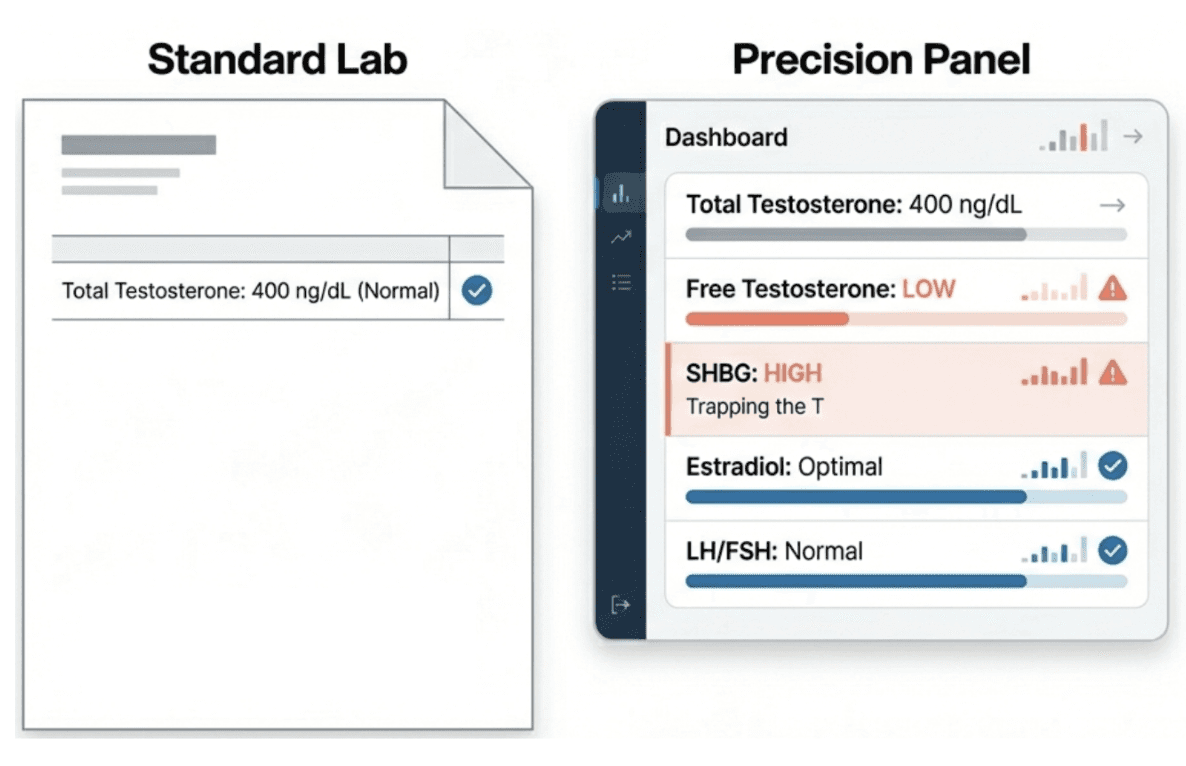
And don’t stop at just total testosterone. At Catalyst, we test:
Total Testosterone
Free Testosterone (the active form)
SHBG (Sex Hormone Binding Globulin)
LH & FSH (to understand pituitary signaling)
Estradiol (important for libido and joint health)
DHEA-S (a precursor hormone tied to resilience)
What’s “Normal” Isn’t Always Optimal
The reference range for testosterone is wide, approximately 300–1,000 ng/dL. But that doesn't mean 310 is ideal.
We consider:
Your age
Your symptoms
Your free T and SHBG levels
Your lifestyle and stress load
Plenty of guys feel terrible with “normal” numbers. Optimization, not normalization, is the goal.
What Happens If It Is Low T?
We never jump straight to TRT (testosterone replacement therapy) unless it’s truly warranted. First, we ask:
Can we stimulate your body to produce more naturally?
Are there lifestyle, sleep, or nutrition factors we can improve?
Are you dealing with stress or burnout that’s suppressing T?
Some clients benefit from clomiphene, enclomiphene, or supplements before ever touching exogenous testosterone.
Some may be clinical candidates for TRT with close monitoring. The protocol is personal, based on your labs, goals, and biology.
Bottom Line
If you feel “off,” it might be Low T, or it might not. The only way to know is to test smart, interpret correctly, and look at the full picture.
At Catalyst, testosterone is just one piece of your optimization puzzle. But it’s a powerful one, if handled precisely.