Most people don’t think about MRI unless something is wrong. But what if you could scan your entire body to detect potential issues before they show symptoms?
That’s the promise of full-body MRI services like Prenuvo, Ezra, and SimonMed, which claim to catch everything from early cancers to aneurysms to fatty liver and disc degeneration.
But do you actually need one? What can these scans reveal, and where do they fall short? Here’s what to know.
What Full-Body MRI Scans Can Detect
Unlike traditional MRI, which is ordered to investigate a specific issue, full-body MRI is a preventive screening tool. It uses non-invasive, radiation-free imaging to scan your:
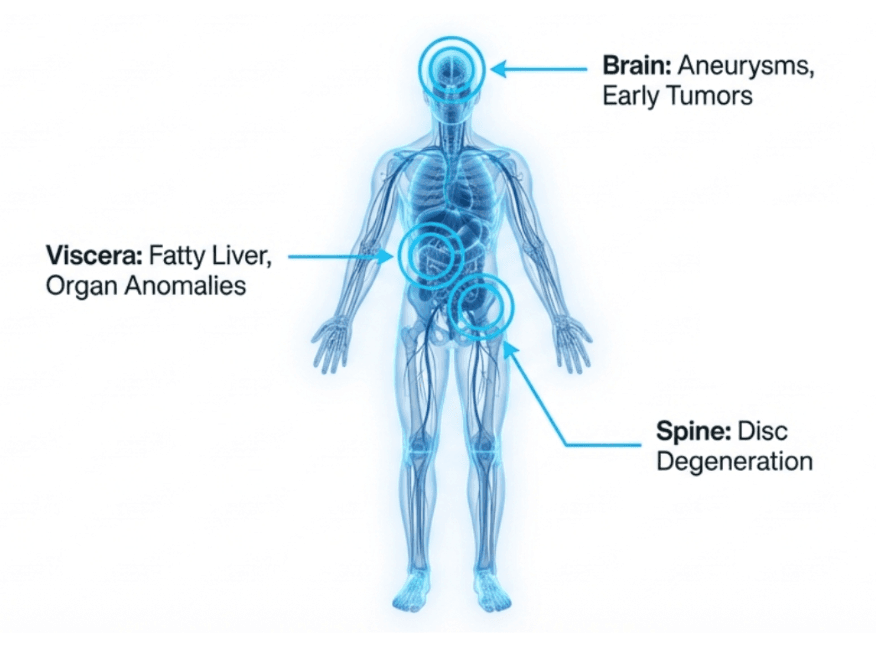
Brain (for aneurysms, tumors, white matter changes)
Spine (disc issues, degeneration, scoliosis)
Liver & Organs (fatty liver, cysts, tumors, inflammation)
Vasculature (abnormal growths or malformations)
Pelvis & Prostate (fibroids, ovarian cysts, prostate nodules)
The Real Value: Peace of Mind or Proactive Detection?
For most people, the appeal is peace of mind. But for others - especially those with family history of cancer, neurodegenerative disease, or autoimmune conditions -it’s a valuable data point in a broader longevity strategy.
A scan may reveal:
Silent disease: asymptomatic tumors, early MS signs, etc.
Subclinical issues: mild disc degeneration or fatty liver before symptoms
Lifestyle consequences: from visceral fat to muscle wasting to inflammation
At Catalyst, we’ve seen cases where a full-body MRI revealed early-stage issues before they would have been flagged by labs or symptoms, allowing clients to course-correct early.
Where It Falls Short
That said, full-body MRI is not a replacement for labs or other testing. It won’t:
Assess hormone levels, micronutrient status, or metabolic flexibility
Track chronic inflammation, gut health, or immune balance
Provide insight into functional performance like VO2 max, HRV, or muscle strength
Evaluate blood vessel functionality (vs just structure)
It’s a structural snapshot, not a dynamic picture. And it may lead to incidental findings, which are no harm to you but can accumulate stress and further unnecessary diagnostic testing pathways.
Is It Worth It?
Consider it if:
You’re over 40 and optimizing for longevity
You have family history of cancer or neurological conditions
You’re experiencing vague, unexplained symptoms despite normal labs
You want a comprehensive baseline before starting a major protocol
Probably not worth it if:
You’re under 35 with no major risk factors or symptoms
You’re expecting “the answers” to fatigue, mood issues, or libido
You’re looking for data you can act on without a provider to interpret and contextualize it
How We Use It at Catalyst
At Catalyst, we don’t routinely recommend full-body MRIs, but they can be a valuable tool when paired with other insights. For example:
Quarterly bloodwork shows rising liver enzymes → MRI confirms mild steatosis
Hormone panels suggest low testosterone → MRI rules out pituitary lesion
Cognitive changes prompt labs → MRI adds neuro-structural context
If a client is in our VIP tier, we may recommend full-body MRI as part of a layered diagnostics protocol, especially when combining structural imaging with DEXA, CIMT, epigenetic age, and comprehensive labs.
The MRI gives us a “snapshot.” Everything else helps us build the movie.
Bottom Line
Full-body MRI isn’t necessary for everyone. But for people optimizing for performance and prevention it can be a powerful tool when used in context.
Want to know if it’s right for you? We can help you decide. And if you do get one, we’ll make sure it actually leads to smarter decisions.